AI Persona Generator: How It Works, Where It Shines, and Where It Falls Short
AI personas are useful when you treat them as simulations, not truth. This guide explains how generators work, where they save time, where they fail, and how to hand findings off to real research.
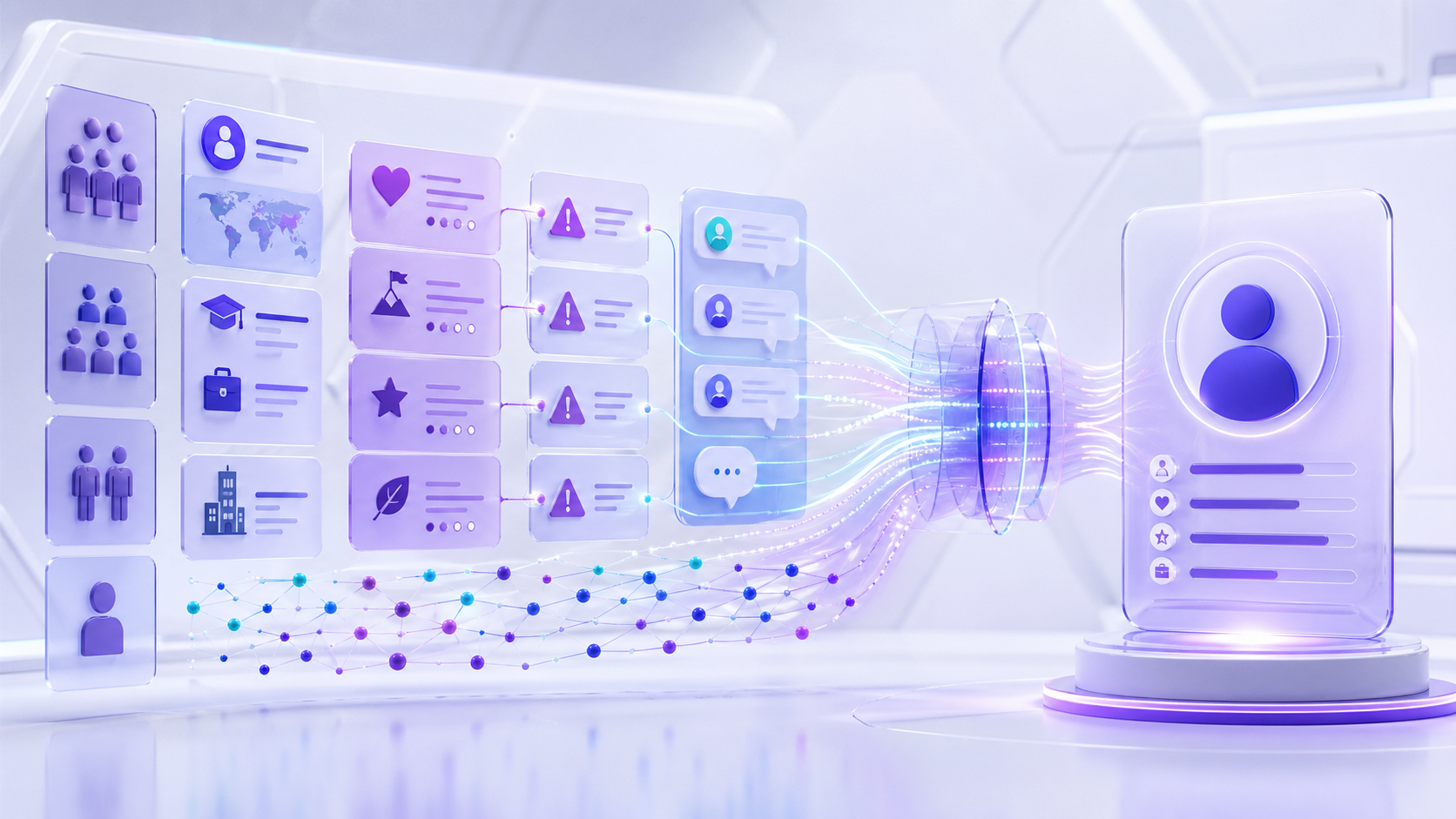
An AI persona generator turns a short prompt into a named, detailed audience hypothesis. It is a simulation, not a substitute for the survey design, recruiting, and synthesis needed to describe a real population. The persona discipline itself is not new. Pruitt and Grudin's Personas: Practice and Theory framed personas as a way to make user research memorable for product teams.
It also gets dismissed by experienced researchers because most AI personas are generic, shallow, and overconfident. Both reactions are right depending on which tool you're using and what job you're hiring it for.
This guide walks through how AI persona generators work in 2026, the use cases where they earn their keep, the use cases where they should be ignored, and the right way to fit them into a real research workflow.
How AI persona generators work
Modern AI persona generators are wrappers around large language models (typically Claude, GPT, or Gemini) with structured prompts that constrain the output to a defined persona shape. For a technical grounding in how this generation of language models behaves, start with the GPT-3 paper.
A useful AI persona is a structured hypothesis
The output should give teams a sharper starting point, not a claim about what real buyers will do.
Role, job, constraints, buying moment, and category familiarity.
The persona should push back, not only prefer things.
Useful personas surface words to test with real customers.
You give the model a description of your product, audience, or use case. The wrapper builds a structured prompt that asks for: a name, age, role, location, demographic context, motivations, pain points, decision criteria, common objections, where they consume information, and how they make purchase decisions.
The model draws on its training data (which may include public web text, product reviews, and research-like language) to generate a persona that feels specific because it includes specific details: a name, a city, a job title, a way of talking. The good ones go deeper and surface the workflow context (what tools the persona already uses, what they wish was different, what they'd never trust). The caveat is the one raised by Bender et al.'s Stochastic Parrots paper: model output can sound fluent without being grounded in the truth of your specific market.
What's happening under the hood: the model is producing a plausible amalgam of what people like the described audience tend to say in its training data. That's powerful when "what people like this audience tend to say" is rich and well-documented. It's much weaker when the audience is niche, novel, or culturally specific.
The 5 places AI personas earn their keep
1. Sharpening discovery scripts before real interviews
You're about to spend money on a recruited customer interview through a platform like User Interviews or Respondent. Before you run the call, you ask an AI persona of the same buyer profile your script questions and watch what comes back. The persona will surface your leading questions, your jargon, your weak assumptions: the script issues that would otherwise burn real interview time.
This is the single highest-leverage use of AI personas: improving the quality of the real research you're about to do.
2. Pre-testing messaging variants
You have a batch of candidate headlines for an ad campaign. Running them past several AI personas lets you eliminate the obvious losers (the ones that confuse the persona, trigger an objection, or come across as tone-deaf) before you spend on a real polling panel like PickFu or a paid traffic test.
Removing a weak-looking headline at this stage narrows the field, but it does not prove that the headline would have lost. Advance the strongest hypotheses to polling or live traffic.
3. Onboarding new team members to your buyer
A new PMM, founder, or marketer can use an AI persona as a repeatable practice partner for mock conversations. Interview access and repetition depend on the account and available credits. NN/g's primer on why personas make users memorable explains the advantage of concrete persona framing in human-research terms.
The catch: the new team member needs to know they're training on a directional simulation, not on truth. Used as a starting point for real customer conversations, this is high-leverage. Used as a substitute, it builds confident wrong intuition.
4. Generating objection lists for sales enablement
Asking an AI persona "what would stop you from buying this?" generates a starter objection list in minutes. Real prospects will surface objections you didn't anticipate, but the AI list catches the predictable ones and arms your sales team with at least the obvious answers before the first real call.
5. Stress-testing concepts before commitment
Before you invest engineering hours, design budget, or campaign spend in a concept, run it past several AI personas representing the audience. The objections you hear are not statistical proof the concept will fail, but if every persona surfaces the same problem, that's a red flag worth investigating with real humans before you commit.
The 3 places AI personas fail
1. Statistical claims about purchase intent
If a sales deck or research report claims "AI personas predict X% of customers will buy this product," close the deck. AI personas cannot predict purchase behavior. They produce plausible reactions grounded in training data; they do not produce probabilistic purchase forecasts. Anyone who says otherwise is either misleading you or doesn't understand what they're using.
Use real customer interviews, real survey data, and real in-market signal as the actual decision basis. Use AI to sharpen and speed those.
Persona research guardrail
2. Truly novel categories or audiences
If your product addresses a brand-new category (something with no real predecessor in the model's training data), the AI persona will hallucinate plausibility instead of reflecting truth. Same problem applies if your audience is a niche subculture, a non-English-speaking market, or a B2B segment where the relevant decision-makers aren't well-represented in public training data.
Test: ask the persona for a specific behavior detail you know from real research (a specific tool they use, a specific phrase they say, a specific objection they raise). If the persona gets it wrong or vague, the AI doesn't have enough training-data signal for your audience and you should weight its output accordingly.
3. Final go/no-go on major spend
An AI persona is not a Stage Gate. If you're about to commit meaningful campaign budget, product-build budget, or your career to a strategic bet, the AI persona is one input among many, and not the strongest one. Use real customer interviews, real survey data, and real in-market signal as the actual decision basis. Use AI to sharpen and speed those.
How AI personas compare to traditional persona research
Traditional persona research is a real research process: customer interviews, survey panels, demographic data pulls, behavioral analytics, and synthesis into a small number of canonical personas that represent your customer base. Done well, it's the gold standard. Microsoft Research's summary of Pruitt and Grudin's persona work is still useful because it treats personas as a complement to other usability methods, not a substitute for evidence.
The problem: most teams that "have personas" got them five years ago, never updated them, and use them as posters in a conference room rather than as living research artifacts.
AI personas don't replace traditional persona research. They occupy a different speed/depth tradeoff:
| Dimension | Traditional persona research | AI persona generator |
|---|---|---|
| Time to first persona | Weeks to months | Near-immediate |
| Cost per persona | Project budget and staff time | Low marginal cost |
| Source of audience detail | Underlying research with real participants | Audience description and model output |
| Updates as audience changes | Rarely | Instantly (regenerate) |
| Statistical validity | Depends on underlying research and sampling | None; synthetic output is a hypothesis |
| Best for | Strategic bets, segment definition | Iteration, sharpening, brainstorming |
The right framing isn't "AI vs traditional." It's "which method for which job." For strategic decisions, lean traditional. For iterative tactical decisions where you'd otherwise just guess, lean AI.
What makes a good AI-generated persona
Not all AI personas are created equal. The ones that are useful share a few traits:
- Specific, not generic. "Maya runs a 1,200 sq ft pilates studio in suburban Phoenix" beats "small business owner in healthcare."
- Includes workflow context. What tools they already use, what they hate about them, what they're afraid to change.
- Includes objections, not just preferences. What would stop them from buying you, not just what they say they'd love.
- Says how they consume information. Where they find tools, who they trust, what makes them dismiss a vendor instantly.
- Includes a "representative quote." Real human language, not marketing fluff.
If your AI persona reads like a generic LinkedIn bio ("marketing manager interested in growth and analytics"), the generator isn't doing its job. The richness is what makes the persona useful for downstream work.
The right workflow for using AI personas
Step 1: Generate. Describe your product or audience in a short, specific brief. Get a specific, named persona back.
Turn AI persona output into better human research
-
Generate
Start with a precise target customer description.
-
Interrogate
Ask for objections, confusion, and tradeoffs.
-
Rewrite
Improve the concept, script, or message.
-
Confirm with humans
Take the strongest questions to real customers.
Step 2: Read critically. Does this persona match your real customer base? If not, refine the description and regenerate. Don't build on a persona that doesn't ring true.
Step 3: Interview. Use the persona as a 1:1 conversation partner. Ask about their workflow, their pains, their objections to your concept.
Step 4: Capture the surprises. The most valuable output isn't the persona doc. It's the moments in the interview where the persona surfaced something you hadn't considered.
Step 5: Take it to real humans. The objections, language, and gaps the AI persona surfaced become the input to your real customer interviews. The AI persona work made the real research sharper.
FAQ
Are AI personas accurate?
AI personas can suggest hypotheses about behaviors, motivations, and objections based on the audience description and model output. They do not establish how common those patterns are or predict purchase behavior, niche-audience reactions, or culturally specific responses.
Can AI personas replace real customer research?
No, and we'd be skeptical of anyone selling that pitch. AI personas are best used as a sharpener for real research: making your interview scripts better, your messaging finalists fewer, your concepts cleaner before they hit real prospects. The teams that get the most value use AI to do more cycles of sharper research, not fewer humans in the loop.
How do I know if a generated persona is good or bad?
Three quick tests: Is it specific enough to picture as a real person? Does it include objections and hesitations, not just preferences? Does it sound like your real customer would? If yes to all three, the persona is useful. If no, regenerate with a more specific input description.
Are AI personas useful for B2B?
Yes, with caveats. AI personas work well for B2B roles that are well-represented in public data: marketing managers, founders, sales reps, product managers. They work less well for senior, niche, or industry-specific roles where the public data signal is thin (CISOs at mid-market healthcare, supply chain VPs at specific industrial verticals).
What's the difference between an AI persona and an AI focus group?
An AI persona is a single buyer profile you can interview 1:1. An AI focus group is multiple personas reacting and responding to each other in a group discussion, useful when you want the dynamic of multiple perspectives in conversation, not just sequential interviews.
Generate your first AI persona right now
The fastest way to understand whether AI personas are useful for your work is to generate one and try interviewing it about something you care about: your product, your messaging, your next campaign concept.
Our free Persona Generator turns a short description into a detailed, named buyer persona without requiring an account. Create a free account when you want to interview it, save it, or use it in a multi-persona study.
If the persona surfaces something useful, take that something to real customers and confirm it. That's the workflow that earns AI personas a permanent spot in your research stack.
Create a free account to interview a persona, save it to your library, or use it in a multi-persona study.