Best AI Market Research Tools, Compared by Research Task
Choose software for the research you need to do, whether you are working through interview recordings or asking customers about a new idea.
Written in Collaboration with AI
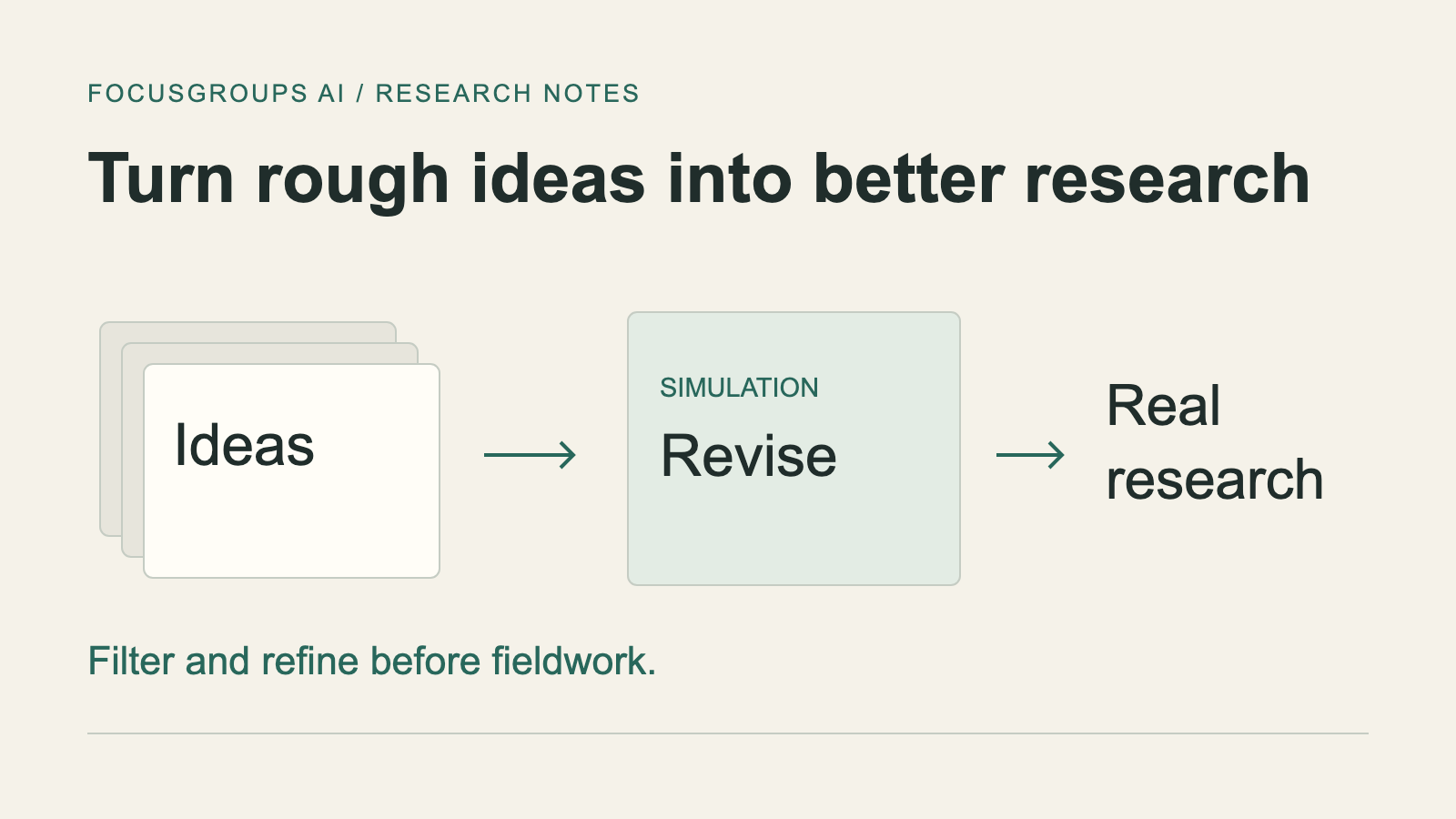
A tool that organizes interview recordings will be useful only if you have interviews to analyze. If you need to hear from customers first, look for software that helps you recruit or interview them. Both kinds of product are sold as AI market research tools, so check what work each one handles before comparing them.
AI market research tools cover very different jobs. Some find public information. Others collect answers from people or organize research you already have. Simulated panels generate responses without interviewing your customers. The sections below explain when each kind of tool is useful and what its answers can tell you.
For help choosing the research method first, see our AI market research guide.
Tools by research task
- Background research on a market: an AI research assistant such as Perplexity's Deep Research.
- Quick reactions from real people: a fast polling panel such as PickFu.
- Surveys and open-ended answers at scale: a survey platform with AI analysis, such as SurveyMonkey.
- Customer interviews without scheduling every call: AI-moderated interviews with real participants, such as Outset.
- Usability and prototype testing: a testing platform such as Maze.
- Making sense of interviews you already ran: a research repository such as Dovetail.
- What people say in public: a social listening platform such as Brandwatch.
- A fast first read before you spend on any of the above: a simulated panel, such as FocusGroups AI (ours) or Synthetic Users.
How we picked these tools
We only included a tool when its own site clearly describes the capability we list. Where a vendor makes a performance claim we could not check, we left it out. We did not include prices for other vendors because several do not publish them and the rest change often. Check each vendor's pricing page before you commit.
Check where a tool gets its answers. A poll with real respondents collects new evidence. Software that analyzes your recordings works with evidence you already have. Simulated respondents generate answers without interviewing your customers.
1. Background research on a market or category
Perplexity Deep Research
What it does: In its February 2025 launch post, Perplexity says Deep Research runs dozens of searches, reads hundreds of sources, and writes a report you can export to PDF or a document. The post says it is free for everyone with a daily limit, with more use on the paid Pro plan.
Good for: a first pass on a category, a list of competitors to look at, and a reading list of sources.
Watch for: a report is only as good as its sources. Open the links behind any number you plan to repeat, and prefer primary sources such as government data or company filings.
If you need public market data, the U.S. Small Business Administration keeps a list of free federal data sources for demographics, spending and industry statistics. Use those sources to check the figures an AI report gives you.
2. Quick reactions from real people
PickFu
What it does: PickFu runs polls with its built-in panel of verified respondents. You write a question, add options, choose an audience and get votes with written feedback. It says results arrive in hours, and it has an AI agent that helps build surveys and read results.
Good for: choosing between two or three options with real people, such as product images, names or ad creative.
Watch for: a preference poll tells you which option people picked, not whether any of them is good enough. Pair it with an open question about why.
3. Surveys and open-ended answers at scale
SurveyMonkey
What it does: SurveyMonkey's AI features page lists building a survey from a text prompt, thematic analysis of open-ended answers, sentiment analysis, response quality detection, and a chat tool for asking questions about your results. It notes that several features depend on your plan and region.
Good for: structured questions to a larger group, and turning hundreds of open-ended answers into themes you can read.
Watch for: AI can write a survey quickly, but it can also write a leading one. Read every question as a respondent before you send it.
4. Customer interviews without scheduling every call
Outset
What it does: Outset runs AI-moderated interviews by video, voice or text, in many languages. Its site says you can recruit participants through Outset or share a link with your own list, and that it produces themes, quotes, reports and highlight reels. It also offers simulated "digital twins" of audiences.
Good for: qualitative interviews with real people when you need more conversations than you can moderate yourself.
Watch for: an AI moderator follows the guide you give it. Spend your time on the discussion guide and on who you recruit.
5. Usability and prototype testing
Maze
What it does: Maze covers prototype testing, live website testing, surveys, card sorting and tree testing, with an AI moderator for interviews and automated reports. Its site says it has a participant panel of more than 6 million people.
Good for: checking whether people can actually use a design before you build it.
Watch for: usability is a different question from demand. A design people can use is not proof they will pay for it.
6. Making sense of interviews and feedback you already have
Dovetail
What it does: Dovetail transcribes calls and interviews, separates speakers, sorts feedback into themes and sentiment, and lets you ask questions that are answered with citations back to the source feedback. It also lists digital twins built from your own customer data.
Good for: teams that already have interviews, support tickets or sales calls and cannot read them all.
Watch for: read the source quotes before reporting an AI-generated theme to your team.
7. What people say in public
Brandwatch
What it does: Brandwatch sells consumer intelligence and social listening. Its site describes monitoring across more than 100 million sources, real-time alerts, and AI for spotting trends, plus a search product for tracking how a brand shows up in search and AI answers.
Good for: brands with enough public conversation to analyze, and teams tracking a category over time.
Watch for: people who post publicly are not a random sample of your customers.
8. A fast first read before you spend on research
Simulated panels use AI personas to react to a message, concept or price. They do not collect evidence from real customers. Use them to look for confusing wording before paying for a study with real participants. Any objections they suggest still need checking with customers.
FocusGroups AI (our product)
What it does: you describe your audience, generate a panel of AI personas, and run a study. The methods on our pricing page include a quick poll, an A/B test of two to four variants, a brainstorm, a one-on-one deep dive interview, and a three-round AI focus group that ends in a report with themes and recommendations. The persona generator is free with no account.
Good for: screening headlines, concepts, names and price framings in minutes before you put the strongest version in front of real people.
Watch for: results are directional. They are a first read, not a measurement of your market. Our synthetic users guide explains where they help and where they do not.
Synthetic Users
What it does: Synthetic Users runs interviews with AI participants, each given a personality profile. Its site lists problem exploration, concept testing and custom script interviews, the option to ground studies in your own transcripts or support tickets, and reports with themes and quotes. It shows per-interview pricing on its homepage.
Good for: teams that want simulated interviews grounded in research they already have.
Watch for: the same limit as any simulated panel. Use it to sharpen hypotheses, then check them with people.
A working paper by researchers at Microsoft and Harvard Business School shows why simulated responses need checking. In their Marketing Science Institute summary, they report that a baseline model could simulate willingness to pay for existing product features, but needed fine-tuning on prior human survey results to do the same for new features, and that fine-tuning may not carry over to unrelated categories. That is a good reason to treat simulated answers as a first read.
How to choose: four questions
Do you need evidence from real customers, or help thinking? If a decision depends on it, such as setting a price or committing to a name, you need real people at some point. Simulation and desk research help you get there with better questions.
Do you already have data? If you have recordings, tickets or survey answers you have never fully read, analysis tools may pay off before any new research.
How fast do you need an answer? Simulated panels return in minutes. Polls with real people can come back in hours. Recruited interviews take longer.
Who will act on it? A founder choosing a headline needs a different tool than an insights team reporting to leadership. Check that the output will answer the question your team needs to decide.
What FocusGroups AI costs
We can only speak to our own pricing. As of November 1, 2026, our pricing page lists a free plan with 10 welcome credits after you verify your email and 3 free credits each month, Starter at $19 a month for 25 credits, Pro at $49 a month for 90 credits, and Scale at $99 a month for 220 credits. A quick poll costs 1 credit, an A/B test 2, a deep dive 3 and a full focus group 5. Failed runs are refunded.
We make FocusGroups AI, one of the tools covered here. Other product descriptions come from the vendors’ own pages, checked November 1, 2026. We have not run a head-to-head test of these tools.
Sources
- Perplexity, Introducing Perplexity Deep Research (February 14, 2025)
- PickFu, SurveyMonkey AI features, Outset, Maze, Dovetail, Brandwatch, Synthetic Users (vendor sites, checked November 1, 2026)
- Brand, Israeli and Ngwe, Using LLMs for Market Research, Marketing Science Institute working paper summary
- U.S. Small Business Administration, Market research and competitive analysis