Copy Testing: 6 Practical Methods and Question Templates
Good copy testing separates confusing language from copy that earns a click. Use these methods and question templates to remove weak headlines fast, then take the strongest variants to real traffic.
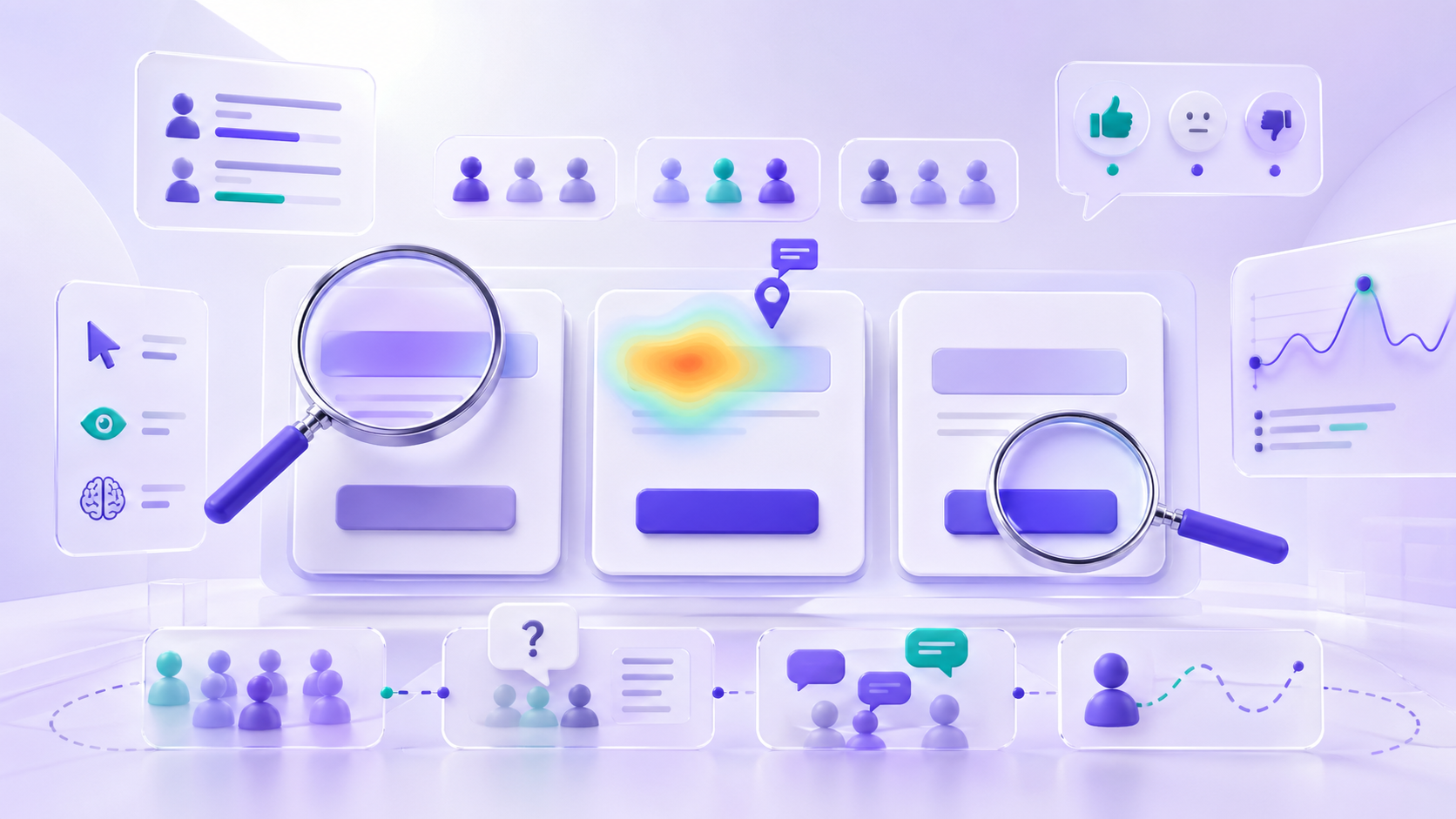
A headline that looks clear inside a working document can confuse a reader who sees it without context. Copy testing exposes those gaps before the copy reaches the full audience.
This guide covers six copy testing methods that move conversion, when each one is worth using, what each one can't tell you, and the question templates that get the most signal per minute.
What copy testing does
Copy testing is the practice of putting specific written language in front of your audience to predict whether it will convert better or worse than the alternative, at the level of headlines, button copy, body paragraphs, ad text, email subject lines. Strong copy usually makes value concrete; Bain's Elements of Value work is a useful outside frame for pressure-testing whether a claim is valuable to the buyer.
It's worth distinguishing from message testing. Message testing operates at the strategic level (what we say, what category we play in, what value prop we lead with). Copy testing operates at the tactical level (which exact words, which sentence order, which call-to-action verb). The methods overlap; the scope and stakes differ.
The honest framing: no copy test is a substitute for live traffic. The goal of pre-launch copy testing is to ship the version least likely to be obviously broken, so that your live test starts from a stronger baseline. Skipping the test doesn't save you time. It just moves the cost of being wrong from lower-cost (a 5-minute AI check) to expensive (a week of paid traffic running on broken copy).
The 6 copy testing methods that work
1. AI persona reaction tests (fastest)
You generate one or several AI personas matching your audience and put your copy in front of each one with a structured prompt: "What's the first thing you think when you read this? What's confusing? What objection comes up?" Because this is built on large language model behavior, keep the same caveats in mind that apply to models like GPT; the Language Models are Few-Shot Learners paper is a useful technical anchor.
Best for: Catching copy that's confusing, jargon-heavy, or accidentally tone-deaf before any human sees it. Iterating 10 headline variants in an hour.
Cannot tell you: Conversion lift. Real click-through rate. Whether your specific buyer would buy. The reaction is directional, not statistical.
Cost: Persona generation is free. A free account includes credits for interviews and other studies.
2. PickFu and similar polling panels
Upload two copy variants, select a target audience (gender, age, region, interest), and get preference responses with written reasoning. PickFu is the canonical lightweight tool here.
Best for: Head-to-head choices when you have a B2C audience and a few finalists. The written reasoning is the real product: read every comment, ignore the win percentage alone.
Cannot tell you: How a sharp B2B audience reacts (panels skew consumer). Whether stated preference matches purchase behavior.
Cost: Depends on panel size and targeting; check current vendor pricing before budgeting.
3. Survey-based copy preference tests
Build a survey in a platform like Qualtrics, SurveyMonkey, or Typeform; recruit through your list or a paid panel; ask respondents to rate a few variants on clarity, appeal, believability, and likelihood-to-act.
Best for: Generating defensible quantitative data for a stakeholder argument. Comparing more than 3 variants where polling panels get noisy.
Cannot tell you: Real conversion. Stated likelihood-to-act is not the same as observed behavior, which is why purchase-intent research like Morwitz and Sun's model of stated intentions and purchases matters.
Cost: Depends on tool, panel, and audience.
4. Live A/B testing on real traffic
Route real visitors to two copy variants on a live page and measure conversion. Tools: Optimizely, VWO, PostHog.
Best for: The closest thing to ground truth. Decisions on high-traffic pages. Resolving internal arguments definitively.
Cannot tell you: Anything fast unless the page has enough traffic and conversions to power the specific lift you care about. Too slow for low-traffic pages.
Cost: Tooling cost plus the opportunity cost of the worse variant.
5. Sales call transcript review
If you have a sales motion, listen to recorded discovery calls and watch when prospects use your messaging language back to you, when they ask for clarification, and when they push back. Tools like Gong or Fireflies make this scalable.
Best for: B2B teams. Catching the gap between "tested well in survey" and "confuses real prospects in conversation."
Cannot tell you: Anything about top-of-funnel inbound where you don't get a conversation.
Cost: Your sales platform's recording cost plus the time to listen.
6. Heatmap and scroll proxies (for landing pages)
Tools like Hotjar, FullStory, and Microsoft Clarity show you where users hover, click, scroll, and rage-click on a live landing page. Where the heatmap dies tells you where the copy lost them.
Best for: Optimizing copy on already-live pages. Identifying which sections are getting read and which are skipped.
Cannot tell you: Whether the copy caused the dropoff or whether it was visual design, page weight, mobile rendering, etc.
Cost: Free tier on Clarity; paid analytics tools vary by plan and traffic volume.
The copy testing question templates that work
The biggest leverage in copy testing isn't the tool: it's the question. These five questions, used in any of the methods above, surface more signal per minute than long checklists.
The four reactions that matter most
Copy testing works when it surfaces what a reader understood, doubted, wanted, and would do next.
If the offer is not understood, persuasion cannot start.
Strong copy makes the right reader feel named.
Objections are rewrite instructions, not annoyances.
The CTA needs a reason, not just a button.
"Without thinking too hard, what does this offer?"
If your audience can't say what you do in one sentence, your copy is broken. This question separates copy that communicates from copy that just impresses. NN/g's work on watching what users do instead of only listening to what they say is the same principle in UX form.
"Who is this for?"
If they can't tell, your targeting language is too vague. Great copy makes the right reader feel seen and lets the wrong reader self-select away.
"What's confusing?"
This one explicit question surfaces many of the issues a long checklist would. People will tell you about jargon, vague claims, and missing context, but only if you ask.
"What objection comes up?"
Critically: ask for the objection, not the praise. The objections are what's blocking conversion. The praise is just politeness.
"What would make you click [primary CTA]?"
This shifts the conversation from opinion to action. The answers, even speculative ones, reveal what the copy is failing to promise or prove.
How to combine these (the tactical workflow)
For most copy decisions you don't need all six methods. Match the method stack to the stakes:
Move copy from rough to traffic-ready
-
Generate rough cuts
Create meaningfully different angles.
-
Run AI reactions
Remove confusing or unbelievable copy fast.
-
Use panels or surveys
Compare the surviving variants with a target audience.
-
Use real traffic
Let behavior decide between polished finalists.
AI works as an early filter, not the final answer.
Copy testing workflow
Low stakes (a single email subject line, a tweet, a button label):
- Stage 1 only: AI persona reaction test on a few variants. Pick a winner. Ship it.
- Total time: minutes. Cost: low marginal cost.
Medium stakes (an ad creative, an email body, a feature page):
- Stage 1: AI persona reaction on several variants. Narrow to a few.
- Stage 2: PickFu or list A/B for the finalists.
- Stage 3: Ship the winner. Optionally A/B against current control on real traffic.
- Total time and cost depend on audience and tool choice.
High stakes (homepage rewrite, paid campaign launch, pricing page):
- Stage 1: AI persona reaction on a broad set of variants.
- Stage 2: Customer interviews where you watch them say the copy back.
- Stage 3: Survey panel for quantitative confirmation.
- Stage 4: Small paid traffic A/B test.
- Stage 5: Live A/B at scale.
- Total time and cost scale with recruiting difficulty, panel quality, and traffic volume.
The pattern: the higher the stakes, the more methods you stack, and AI remains an early filter, not the final answer.
What to look for in test results
Resist the urge to drown your test in metrics. The four signals that matter:
- Comprehension: Can the reader say what you do without re-reading? If not, the copy is failing the most basic job.
- Specificity: Does the reader feel like the copy was written for them, or for "everyone"? Specific copy converts; generic copy doesn't.
- Believability: Are the claims supported by anything? "Dramatically faster" needs proof. "The world's best" almost always backfires.
- Friction: What's the one objection that comes up most often? That's your conversion ceiling until you address it.
Common copy testing mistakes
Testing without a control. A standalone "do you like this?" gives you no information. Always test variants against each other or against your current copy.
Testing with the wrong audience. Internal teams, friends, and Twitter audiences are not your buyer. Use a panel that matches your real ICP.
Optimizing for the wrong metric. Likability doesn't predict conversion. Click-through doesn't predict purchase. Define your success metric before the test, not after.
Stopping after one round. The point of copy testing is iteration. If you test once, pick a winner, and ship, you've left signal on the table. The biggest gains usually come in the second or third revision.
Treating AI reactions as proof. They're directional. Real conversion comes from real traffic. Use AI to remove the broken; use traffic to find the truly best.
FAQ
What's the difference between copy testing and A/B testing?
A/B testing is one method within copy testing: specifically the live-traffic comparison. Copy testing is the broader umbrella that also includes pre-launch survey, polling, AI persona, and interview methods.
How many people do I need for a copy test to be statistically valid?
For polling panels and surveys, sample size depends on the confidence level, audience incidence, and decision risk. For qualitative usability-style work, NN/g's five-user guidance explains why small repeated rounds often beat one big round. For live A/B tests, use the effect size and conversion rate to calculate the required sample before launching.
How predictive are pre-launch copy tests?
Consistent results across AI, polling, and survey methods can justify moving a variant into a live test. They do not predict conversion. Treat every pre-launch winner as a hypothesis until real audience behavior confirms it.
Can I copy-test with ChatGPT or Claude directly?
You can. A structured persona simulator uses a specific audience description and consistent profile across the test, which can make the feedback easier to compare. It remains synthetic directional input, not buyer evidence.
How fast should I expect copy testing to be?
AI persona reaction is the fastest. PickFu-style polling can be same-day. Survey panels, customer interviews, and live A/B tests take longer because they depend on recruiting, fielding, and traffic. Match the speed to the stakes.
Pressure-test your next headline right now
If you've got a headline, an ad hook, or a value-prop sentence sitting in a doc waiting to ship, you don't have to wait for a real test to start sharpening it.
Generate a buyer persona with our free Persona Generator, then use a free account to interview it about the copy. Treat the reaction as a prompt for revision, not proof that the copy will convert.
Then take what survives that filter to a real audience.
Start free to compare copy variants with multiple personas, then move the strongest version to real traffic.