Customer Discovery for SaaS Founders: A Step-by-Step Playbook
Most SaaS customer discovery fails because founders pitch instead of listening. Use this playbook to recruit better prospects, ask questions that surface behavior, and rehearse with AI personas before real buyer calls.
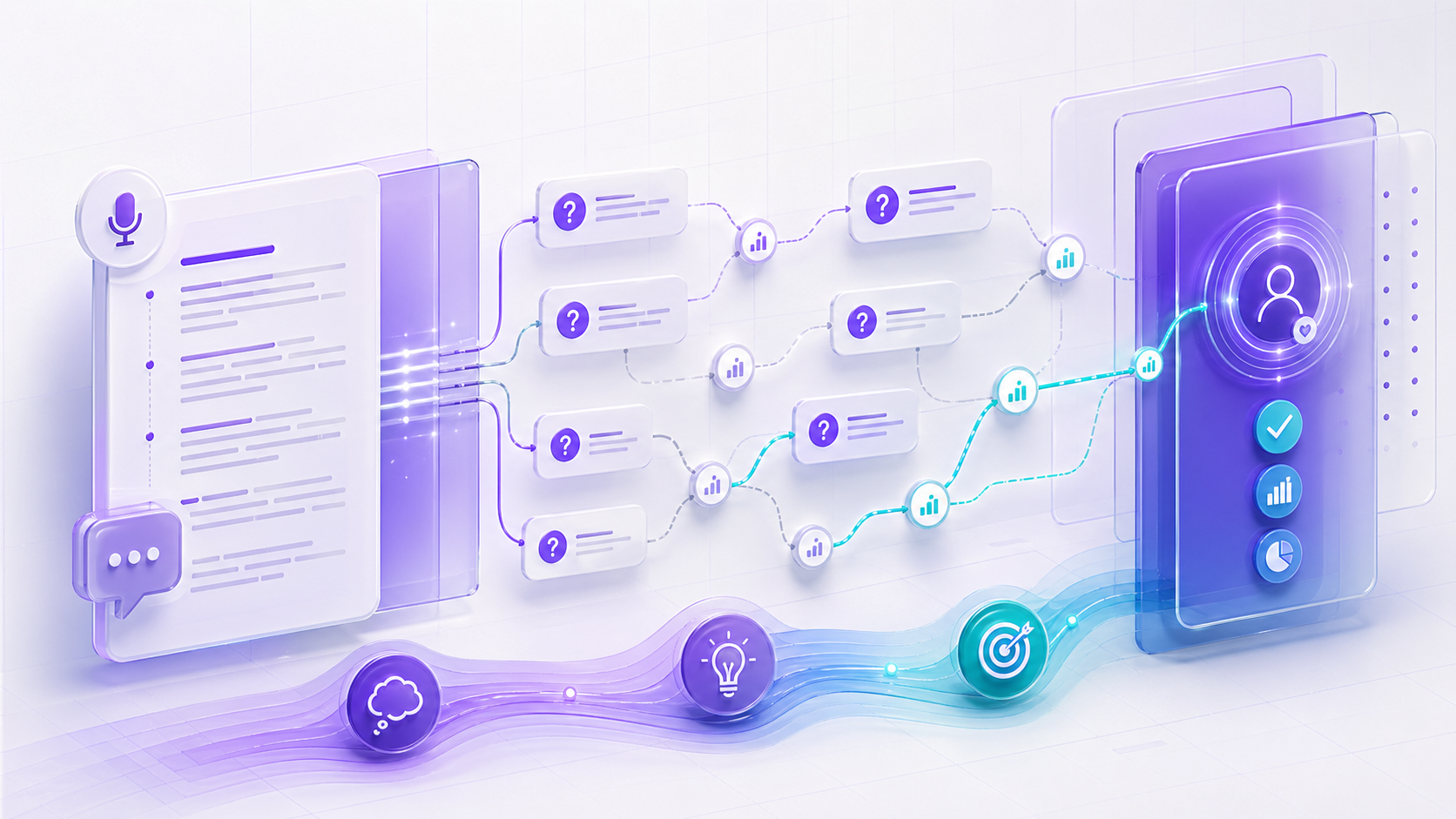
Most early SaaS founders skip customer discovery. Not because they don't know they should do it, but because they don't know what it looks like. They schedule a few "user calls," demo their idea, hear "that's interesting," and walk away convinced they're onto something. Six months later they ship and nobody buys.
That's not customer discovery. That's a sales pitch in a research costume.
Real customer discovery has one job: learning whether prospective buyers experience the problem you want to solve, in their own words and through examples of past behavior. Done well, it changes what you build. Done poorly, it confirms what you already wanted to believe.
What customer discovery means
Customer discovery is the first stage of Steve Blank's customer development model: the deliberate effort to find out whether the problem you're solving is real, painful, and worth paying for before you commit to building the solution. It also overlaps with the Mom Test discipline of asking about real behavior instead of fishing for compliments.
It is explicitly not:
- A demo of your product
- A pitch to a friendly user
- A survey asking "would you use this?"
- A meeting where you do most of the talking
It is:
- Open-ended conversations with people who match your target customer profile
- Focused on their current behavior and pain, not your future product
- Designed to disconfirm your assumptions, not confirm what you already believe
- Repeated until you stop hearing new patterns, using small qualitative rounds as a learning loop rather than treating one call as proof
The mental shift that separates good discovery from bad: your goal is to be wrong as cheaply as possible. Every interview where you confirm what you already believed is a wasted interview. Every interview that surprises you is a gift.
The 5 questions that work
The hardest part of customer discovery isn't finding people to talk to; it's resisting the urge to pitch them. These five questions are designed to force a real conversation about behavior, not opinions.
Good discovery questions force behavior, not opinions
Before a real call, every question should pass these checks. AI personas are useful for catching the misses early.
Ask for the last real example, not future hypotheticals.
Find the event that made the old way unacceptable.
Map who uses, blocks, funds, or approves the change.
1. "Walk me through the last time you tried to [job your product addresses]."
This is the single most valuable question in customer discovery. It pulls a real story out of memory instead of letting the person speculate about hypotheticals. People are notoriously bad at predicting their future behavior; purchase-intent research has repeatedly found gaps between what people say they will do and what they later do, including a unified model of stated intentions and purchase behavior. They're much better at recalling what they did last week.
Listen for: tools they tried, workarounds they invented, frustration points, who they involved, how long it took, what they ultimately settled for.
2. "What did you try before that?"
If they already use a tool for this job, what came before it? Why did they switch? This tells you the bar a new entrant has to clear and what causes the switching pain. The framing is close to Clayton Christensen's Jobs-to-be-Done theory: customers "hire" a product in a circumstance, not in a vacuum.
3. "What made you start looking for a better solution?"
This is the trigger event. Buyers don't change tools because tools are imperfect. They change because something happened that made the imperfection finally unacceptable. If you can identify the trigger event, you know exactly when to be present in the buying journey.
4. "What did you wish [the tool/process] could do that it couldn't?"
This surfaces unmet needs without prompting them with your solution. The answers will sometimes confirm your hypothesis and sometimes wreck it. Both are useful.
5. "Who else inside your company cares about this?"
For B2B, this maps the buying committee. The user is rarely the buyer. The person you're talking to may not have signing authority and may need to convince other stakeholders. Gartner's B2B buying journey research is useful here because it frames buying as a nonlinear set of jobs, including consensus creation. Knowing who those people are shapes everything from your messaging to your sales motion.
Where to find real prospects (without bothering your network)
The biggest barrier to good customer discovery is recruiting. Your friends and your existing customers are not your target: friends will be too generous, existing customers already self-selected. Here's where the real ones are:
For B2B SaaS:
- User Interviews: recruit specific roles and screen by company size.
- Respondent: strong for senior B2B buyers and professional audiences.
- LinkedIn cold outreach: slow but free; offer a credible incentive for a short call.
- Industry Slack communities and subreddits: post asking specifically for stories, not for opinions.
For B2C:
- Reddit (find subreddits where your customer hangs out)
- Facebook groups for the niche
- Public reviews of competitors: read, then DM the reviewer for a short call.
The cost-per-interview for cold-recruited B2B sessions is usually meaningful once you factor in incentive, screening, scheduling, and your time. That math is what makes pre-interview script sharpening so valuable.
How to use AI personas to sharpen your script (without lying to yourself)
This is where AI fits into customer discovery, and we want to be precise about it because it's easy to misuse.
Use them to sharpen the script. Use real humans to find the truth.
Discovery guardrail
AI buyer personas, generated to match your target customer profile, are useful for one specific job in customer discovery: pre-interview script rehearsal. You run your planned questions past a few AI personas representing your target audience and watch what they say. Specifically, you watch for:
- Leading questions you didn't realize were leading. AI personas will give you the answer you steered them toward, just like real humans will. If your AI persona keeps saying "yes, that sounds great" you're prompting wrong, not because they liked your idea.
- Assumptions baked into your questions. "How often do you use [category of tool]" assumes they use one. The AI's response will surface what happens when that assumption breaks.
- Vocabulary mismatch. If your script uses jargon your buyer wouldn't, the AI persona's confused or off-topic responses will surface it before a real human politely tries to answer anyway.
What AI personas cannot do, and we want to be honest about this:
- Tell you whether the problem you're investigating is real
- Tell you whether someone would pay for your solution
- Surface the surprising stories, edge cases, and emotional moments that real humans bring
- Map your specific buyer's actual workflow with their actual stack
The right mental model: an AI persona is a script-rehearsal partner, not a source of truth. Interview access depends on the account and available credits. Use the simulation to sharpen the script. Use real people to learn what is true.
The discovery interview itself: a 30-minute structure that works
Once you've sharpened your script, here's the actual call structure that surfaces the most signal:
A simple interview arc that avoids pitching
-
Set the frame
Make it clear you are learning, not selling.
-
Stay in their world
Ask about current behavior before your idea enters.
-
Introduce concept late
Only ask what is missing if there is time.
-
Ask for referrals
Use every good call to find the next qualified buyer.
Opening: Set the frame. "Thanks for the time. To level-set: I'm not selling anything today, I'm trying to learn about how you currently handle [topic]. There are no right answers. I'm just hoping for honest stories about your real experience."
Their world. Walk through the questions above. Stay in their world, not yours. Resist the urge to say "we're building something for that." If they ask what you do, give a one-sentence answer and steer back: "I'd love to come back to that. First, can you tell me more about..."
Concept (only if there's time). If the conversation has been valuable and they're still engaged, briefly describe your concept and ask: "What's missing from this?" Note: you're asking what's missing, not whether they like it. Likes are lower-cost. Specific gaps are gold.
Wrap. "Who else in your role should I be talking to?" Referrals are the lowest-cost source of qualified next interviews.
Record the call (with permission). Take notes after, not during, so you can stay present.
How to synthesize what you hear
Eight interviews of unsynthesized notes is just trivia. Here's how to turn it into decisions:
After each interview: write a one-paragraph summary while the call is still fresh. The format we like: "The biggest pain in [their world] is [pain]. They handle it today by [workaround]. The trigger that would make them seriously look for something new is [trigger]. The deal-breaker for any new tool is [deal-breaker]."
After every small batch of interviews: read all the summaries side by side. Look for patterns: words that show up in multiple summaries, pains that repeat, triggers that recur. The patterns are your discovery findings. The outliers are interesting but rarely actionable. NN/g's small-sample usability guidance is not a customer-discovery rulebook, but it captures the useful principle: repeated qualitative rounds beat one oversized round.
After enough interviews per segment: you should be able to write your segment's "story" in one paragraph and have it ring true to anyone who's read all the transcripts. If you can't, do more interviews.
Common mistakes that ruin customer discovery
Pitching instead of listening. The most common failure mode. If your transcript shows you doing most of the talking, you're pitching, not learning.
Asking about the future. "Would you use a tool that did X?" is worthless. People are bad at predicting their behavior. Ask about the past.
Talking only to the wrong people. Friendly users, friends, employees, advisors. They're not your target. They love you and want you to succeed. They will not give you the truth.
Stopping after the first few interviews. A tiny sample is barely enough to surface a single pattern. The real signal compounds as you hear the same pain from different mouths.
Ignoring negatives. If half your interviews suggest the problem isn't urgent, that's the most important data you have. Listen to it.
FAQ
How many customer discovery interviews do I need?
Per segment, you need enough interviews to hear repeated behavior patterns from people who match the same buying situation. If each call sounds different, keep going; if the same triggers, pains, and objections keep recurring, move to the next segment or the next research phase.
Is customer discovery the same as user research?
Related but not identical. Customer discovery is upstream: you do it before you have a product, to figure out whether to build at all. User research happens once you have a product, to figure out how to make it better. The interviewing skills overlap; the questions don't.
How long should each interview be?
A short, focused call is the right default. Too short and you can't get past pleasantries. Too long and you're imposing on busy people, which makes recruiting harder.
Can I do customer discovery purely through surveys?
No. Surveys can supplement interviews, particularly for quantifying patterns you've already heard, but they can't replace them. The whole point of discovery is hearing the unscripted stories, the emotional moments, the language people use. Surveys flatten all of that.
How do I get senior B2B buyers to take a discovery call with me?
Three things help: be specific about what you're learning ("I'm researching how Series A SaaS CFOs evaluate revenue forecasting tools"), keep the ask short, and offer an incentive that respects their time. Senior buyers are time-poor but many will share if the framing is professional.
Start your discovery cycle today
You don't need a research budget to start. You don't need a recruiting platform. You don't need a fully-built script.
What you need is one buyer profile in your head, three questions ready to go, and the discipline to ask about the past instead of the future.
Before the first real call, use our free Persona Generator to create a target buyer without an account. A free account unlocks 1:1 chat. Use that rehearsal to find leading questions and jargon, then rely on real interviews for evidence.
Then go talk to real humans.
Create a free account to rehearse a discovery interview, improve the script, and save the real conversation for questions only a customer can answer.