Online Focus Groups in 2026: How They Work, What They Cost, and the AI Alternative
Online focus groups are still powerful when you need real human discussion, but they are not cheap or instant. This guide covers platforms, costs, workflow, and how AI can sharpen the work before recruitment.
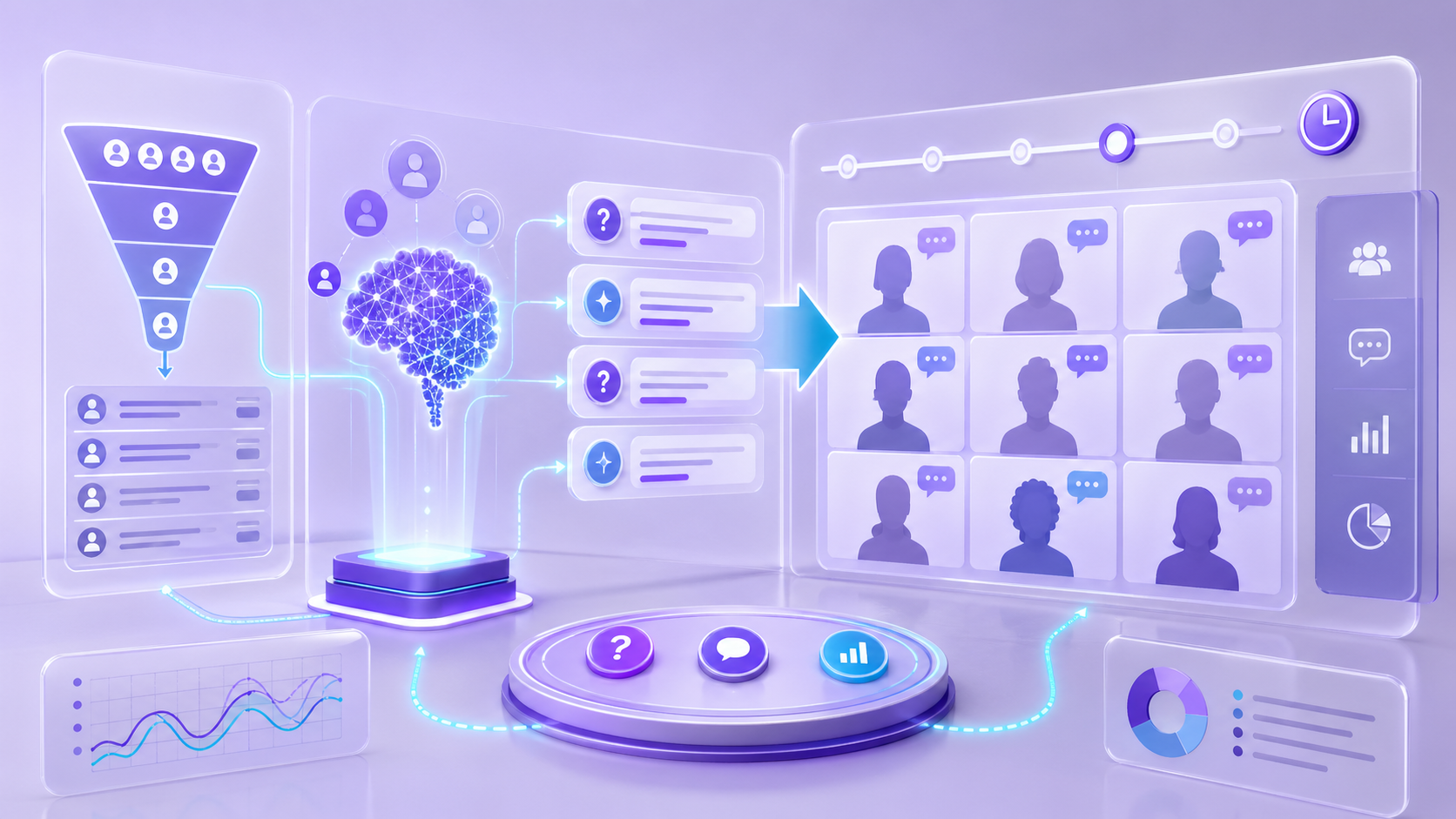
Online focus groups can reduce travel and broaden recruitment while preserving moderated discussion. They also lose some physical and group-room context. Academic work on virtual focus groups has examined those tradeoffs for years.
This guide is the practical 2026 picture: how online focus groups work, what they realistically cost, the platforms that matter, and where AI-based alternatives fit alongside (not instead of) them.
What an online focus group is
An online focus group is a moderated qualitative research session conducted over the internet, usually with recruited participants and a trained moderator running a discussion guide. The format breaks into two main types; iTracks' online qualitative research guide is a practical overview of the synchronous/asynchronous split.
Synchronous (live): Everyone is online at the same time on a video platform. The moderator runs the discussion in real time, participants react and respond to each other, the session is recorded for analysis. Closest to traditional in-person.
Asynchronous (diary/bulletin board): Participants log in over several days to respond to prompts at their own pace. The moderator engages between responses, and threads emerge over time. Better for topics that benefit from reflection, lifestyle context, or longitudinal observation.
Both deliver the core thing focus groups exist for: qualitative depth from real recruited humans, with the dynamic of multiple perspectives reacting to each other in conversation.
Why teams choose online groups
Remote work made video participation more familiar and widened the pool of people who can join without traveling. Common advantages include:
- Wider geographic reach. A single online session can include participants from multiple markets. In-person studies effectively cap at one metro per session.
- Faster recruiting. No facility logistics; participants self-select into available slots.
- Lower per-session cost. No facility rental, no travel, smaller incentives.
- Easier client observation. Stakeholders can watch from anywhere, in their own context.
- Higher participation diversity. Working parents, rural participants, and people who'd never travel to a research facility are accessible.
What in-person still wins on: research that depends on physical interaction with a product (food and beverage tastings, packaging handling, in-store experiences), and topics where body language and group energy matter more than text-rich responses.
The major online focus group platforms
Recollective
Strong for asynchronous studies and longer-running research panels. Mature platform with good moderation tools, strong reporting, and flexible study formats. Used heavily by enterprise research teams. Pricing is generally scope-based, so get a quote against the actual study design.
Choose based on the session you need
Online focus group tools differ less by buzzwords and more by recruiting, moderation, stimulus handling, and analysis workflow.
Panel quality shapes the usefulness of every conversation.
The guide and moderator decide whether the group produces depth.
Outputs should feed the next product or marketing decision.
Forsta (formerly FocusVision)
Enterprise-grade with strong infrastructure for both qualitative and quantitative research. Includes synchronous video focus group tools alongside survey and panel management. Pricing reflects the enterprise positioning.
Discuss.io
Synchronous video focus group platform with strong moderation tools, automatic transcription, and clip-creation for stakeholder reporting. Good middle-ground between heavyweight enterprise tools and DIY video calls.
iTracks
Specialized in online qualitative research with both synchronous and asynchronous options. Strong on bulletin-board style studies. Niche but well-regarded by qualitative research professionals.
QualBoard
Digital qualitative platform now offered by Sago. Strong for diary studies and multi-day discussions. Good for lifestyle research and longitudinal qualitative work.
Lower-cost alternatives (Zoom + DIY recruiting)
For smaller studies, many teams skip dedicated platforms entirely. Recruit participants via User Interviews or Respondent, run the session on Zoom with a designated moderator, transcribe with Otter.ai or Fireflies, analyze in a doc or in Dovetail. Less polished than dedicated platforms but a fraction of the cost.
What an online focus group costs in 2026
Realistic cost ranges depend on platform, recruit difficulty, moderation, reporting depth, and whether you bring participants yourself. Many dedicated platforms are quote-based, so treat any number you see online as a starting assumption, not a budget.
Enterprise online focus group via dedicated platform:
- Single synchronous session: usually quote-based because recruit, platform, moderation, incentives, and reporting are bundled
- Multi-session study: materially higher because every segment or market adds recruit and moderation work
- Asynchronous bulletin-board study: often more synthesis-heavy because the discussion unfolds over time
- Includes: recruiting, platform, moderator, recording, analysis report
- Timeline depends on recruit difficulty, fielding length, and reporting depth
Mid-market online focus group with lighter platform:
- Single session: lower overhead than enterprise programs, especially if you bring participants
- Faster timeline when recruiting criteria are simple
- Research quality depends on participant fit, moderation, and analysis, not the platform tier alone
DIY online focus group (Zoom + DIY recruiting):
- Recruiting via User Interviews or Respondent: incentive and recruiting fees depend on audience incidence
- Participant count depends on the discussion design and no-show risk
- Plus your time for prep, moderation, analysis, and reporting
- Timeline depends mostly on recruit difficulty
A DIY approach can cost less when the team already has recruiting, moderation, and analysis skills. Compare staff time, participant incentives, recruiting fees, platform costs, and reporting needs before deciding it is the lower-cost option.
How an online focus group runs
For a typical synchronous online focus group:
Pre-session:
- Define research objectives and write a discussion guide
- Define participant criteria and recruit enough qualified people to account for no-shows
- Schedule the session length around topic depth and participant fatigue
- Send participants tech-check instructions and pre-session homework if applicable
The session itself:
- Introductions, ground rules, warm-up question
- Open discussion of the research topic (current behavior, pain points)
- Reaction to specific stimuli (concepts, ads, prototypes, messaging)
- Deeper exploration of themes that emerged
- Wrap-up and final thoughts
Post-session:
- Transcribe the recording
- Tag responses by theme
- Synthesize findings into a report
- Pull video clips that illustrate key themes for stakeholder presentation
The session itself is the visible part. The pre- and post-session work often accounts for most of the total project time and cost.
Where online focus groups still produce signal nothing else does
Even with the rise of AI-based alternatives, traditional online focus groups produce specific kinds of signal that no other method matches:
Group dynamics. When one participant says something that sparks disagreement from another, the resulting back-and-forth surfaces tensions and tradeoffs that wouldn't appear in 1:1 interviews. This is the irreplaceable strength of focus groups as a method, and it is central to Morgan's methodological review.
Emotional and tonal nuance. A trained moderator reads hesitation, body language (yes, even on video), and the tone of "well, I guess..." that flags an answer the participant doesn't fully believe.
Surprises grounded in real lived experience. The thing you didn't think to ask about, that emerges because a participant volunteered a story you couldn't have predicted.
Defensible legitimacy. When research findings need to be presented to a board, regulator, or skeptical stakeholder, "we recruited real participants across multiple sessions" is a story everyone takes seriously.
Where AI alternatives fit
AI-based research tools (including ours) don't replace the above. They occupy a different space in the workflow:
AI alternatives occupy a different role in the research stack: fast, lower-cost pre-research and iteration.
Online research stack
Pre-research sharpening. Before you spend real budget on an online focus group, run your concepts past AI personas to surface the obvious problems, refine the wording, and narrow which versions to test. This makes the real research budget go further.
Iterative messaging tests. When you need to test many versions of an ad headline and only a few are worth taking to a real focus group, AI handles the filter step in an afternoon.
Brainstorming and ideation. When you don't yet know what's worth testing, AI personas help generate the candidate list.
Sales and marketing enablement. Objection lists, mock conversations, and draft talking points can provide directional input at a low, credit-dependent compute cost.
The right framing isn't "AI replaces online focus groups." It's "AI handles the lower-cost pre-research filter that focus groups used to handle slowly and expensively." The two methods are stages, not substitutes.
The workflow that uses both
For most teams in 2026 with a meaningful research need:
Use AI before recruitment, not instead of recruitment
-
Pre-research
Use AI personas to find weak stimuli and questions.
-
Recruit real people
Spend only after the discussion guide is sharper.
-
Moderate online
Capture real language, emotion, and group dynamics.
-
Synthesize
Turn findings into the next testable decision.
Stage 1: AI sharpening. Use AI focus groups to iterate concepts, narrow message variants, and remove obvious problems. Output: a focused set of questions and finalists worth testing on real humans.
Stage 2: Online focus group on the finalists. Spend the real research budget, but only on the version of the research that's already been sharpened. The focus group budget goes further because you're not testing broken ideas.
Stage 3: Quantitative survey to confirm qualitative signal. Take the strongest theme from the focus group to a panel for statistical confidence.
Stage 4: In-market test. Run the chosen direction as a real campaign or product element with measurable conversion.
Skipping Stage 1 means your focus group budget gets spent on filtering. Skipping Stage 2 means you ship without the depth that real human research provides. The methods aren't substitutes; they're stages.
Common online focus group mistakes
Recruiting from the wrong population. lower-cost recruiting often pulls participants who don't match your target. The cost savings disappear in the analysis when none of the responses reflect your real buyer.
Letting one participant dominate. A skilled moderator manages this; an unskilled one lets it derail the session.
Asking leading questions. "Wouldn't it be great if X?" gets you yes. "Walk me through the last time you tried to do X" gets you truth.
Skipping the pre-session homework. Sending participants a short reflection prompt before the session dramatically improves the quality of in-session discussion.
Treating the session recording as the deliverable. The recording is raw material. The deliverable is synthesis: patterns, themes, illustrative quotes, decisions.
FAQ
How many people should be in an online focus group?
Keep the group small enough that people can interact. Too few participants limits perspective diversity; too many makes conversation hard to moderate and individual voices easy to lose.
How long should an online focus group last?
Long enough to get past surface reactions, short enough to avoid fatigue. Asynchronous studies can run over several days because participants respond at their own pace; the asynchronous online focus group literature is useful for understanding that tradeoff.
When are online focus groups a good alternative to in-person?
Online groups can work well when geographic reach, scheduling, and stakeholder access matter more than physical context. They give up some body-language and group-energy signal. In-person remains stronger for product handling, sensory testing, and studies where the room itself is part of the evidence.
How much does an online focus group cost compared to in-person?
Online is usually cheaper than in-person when it removes facility rental and travel. The recruiting, moderation, and analysis costs are still real, which is why a lower-cost platform does not automatically mean lower-cost research.
Can AI focus groups replace online focus groups entirely?
No. They occupy a different role in the research stack: fast, lower-cost pre-research and iteration. They don't produce the depth, group dynamics, or defensible legitimacy that real-human online focus groups provide. The teams getting the most value use both: AI for the pre-research sharpening, real online focus groups for the decision-support work.
Try the AI-first pre-research step right now
If you're planning a real online focus group and want to make the budget go further, the highest-leverage thing you can do is sharpen your concepts and questions before you commit to recruiting.
Generate a buyer persona with our free Persona Generator, then create a free account if you want to interview it. Use the objections to improve the real discussion guide, and use recruited participants for evidence about actual buyers.
Create a free account to test the discussion guide with synthetic personas before recruiting the real group.