Market Research for Startups: How to Do It on a Small Budget
Before building, find out how a potential customer handles the problem now and what it costs them. Use what you learn to choose the next test.
Written in Collaboration with AI
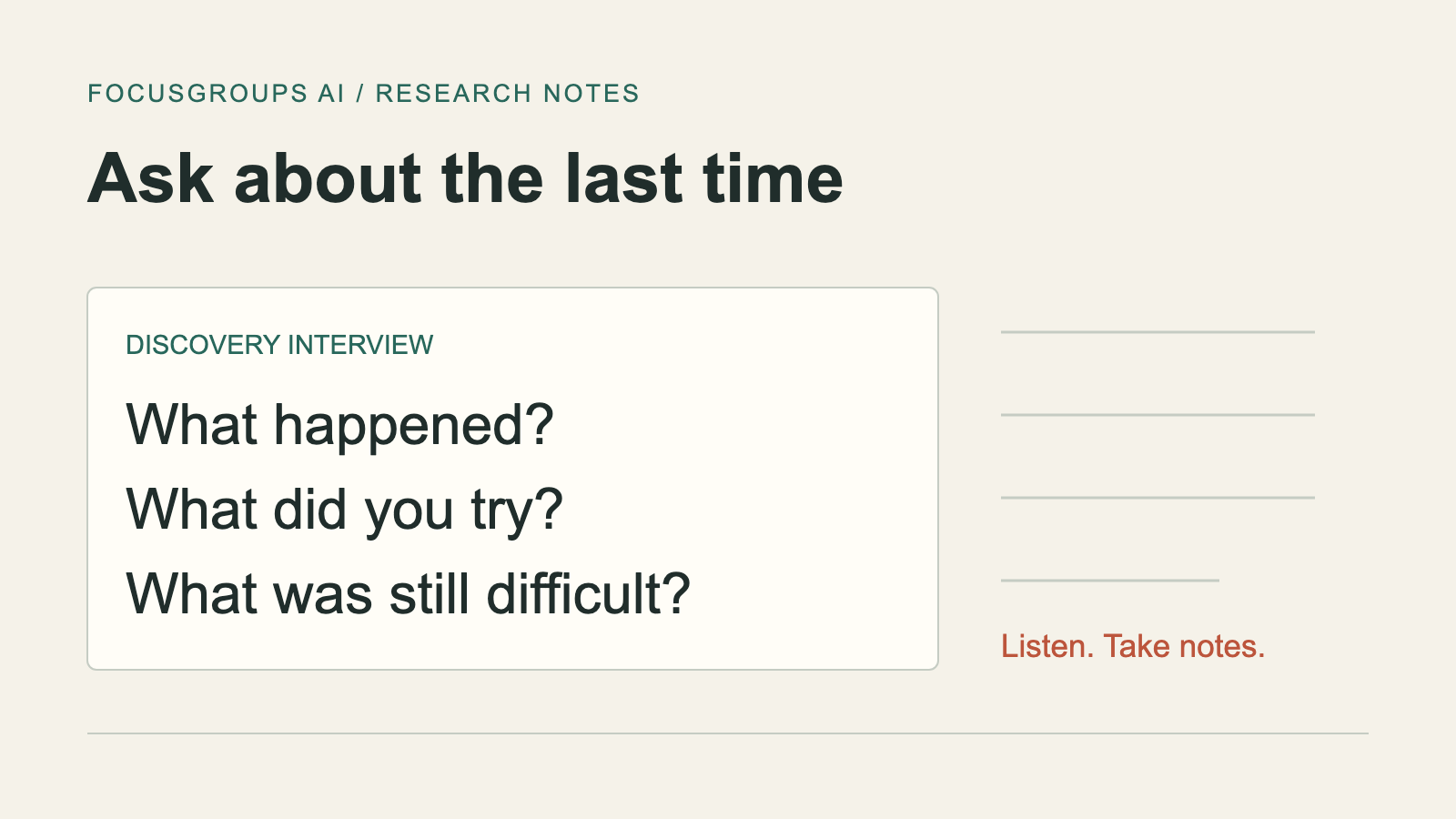
Before you pay to build a product, ask a potential customer to show you how they handle the problem today. What goes wrong? What have they already tried? A recent example will tell you more than asking whether they like your idea.
You can begin with a few conversations and the information available for free. Use what you hear to decide which assumption needs testing next. Spend more only when you know what decision the research needs to support.
Step 1: Write down your riskiest assumption
Write down what has to be true for your business to work. Check these assumptions:
- The problem: a specific group of people has this problem and it costs them time, money or stress.
- The buyer: someone in that group can and will pay to fix it.
- The solution: your approach is better than what they do today, including doing nothing.
- The price and channel: you can reach them and charge enough to make the numbers work.
Start with the assumption that would force you to change the business if it were wrong. If you have not yet spoken to potential buyers about the problem, do that before testing a logo.
Step 2: Do free desk research first
Desk research (also called secondary research) means using information someone else already collected. It is free or cheap, and it answers the questions that do not need your customers' opinions: how big a group is, what they earn, what they spend, who already sells to them.
The U.S. Small Business Administration lists free federal sources for exactly this, including the Census Bureau, the Bureau of Labor Statistics and the Census Business Builder (SBA market research guide). It also describes a basic competitive analysis: list competitors by product and segment, then look at their strengths, weaknesses and barriers to entry.
Start with sources you can read for free:
- Read competitors' pricing pages. They show how the market already packages and prices the value you plan to sell.
- Read their one-star and three-star reviews. Look for problems reviewers describe with the product they already use. Follow up in interviews rather than assuming the reviews represent all buyers.
- Search the communities where your buyers ask for help. Note the exact words people use to describe the problem. Those words become your interview questions and, later, your copy.
Step 3: Talk to people about their past, not your idea
In direct conversations, or primary research, ask about a problem the person has dealt with. If you spend the call pitching your idea, a polite response can be hard to distinguish from interest in buying.
Rob Fitzpatrick's book The Mom Test was written for this problem: how to get useful learning from customer conversations "even when everyone is lying to you." The core habit is to ask about what people actually did, not what they would do.
Ask for examples:
- "Tell me about the last time this happened."
- "What did you do about it?"
- "What did that cost you, in time or money?"
- "What have you tried? What was still hard after that?"
- "Who else was involved in deciding?"
Be cautious with hypothetical questions such as "Would you use this?", "Do you think this is a good idea?", "How much would you pay?" Our customer discovery playbook has a fuller interview guide.
Where to find people for free: your own network's second-degree contacts, the communities from Step 2, and people who left reviews of competitors. As answers start repeating, check whether you have heard from the different kinds of buyers you intend to serve. Repetition in a few conversations does not establish how common a view is across your market.
Step 4: Use an AI panel to prepare, not to decide
AI panels are a cheap way to rehearse before you spend real people's time. A panel of AI personas, generated to match the customer you describe, can react to your problem statement, your pitch or two versions of a landing page headline in minutes.
Use the simulated responses to prepare your interviews:
- Find confusion early. If an AI panel misreads your one-line description, check the wording with real visitors. The simulation alone cannot establish how they will read it.
- List objections to probe. Take the objections the panel raises into your real interviews and see which ones real people bring up unprompted.
- Narrow options. Use the generated comments to revise a shortlist for testing with people. The simulation cannot identify which options real buyers will prefer.
What it cannot do is tell you that real buyers will pay. Treat every result as a hypothesis. On FocusGroups AI, the persona generator is free with no account, a free account comes with 10 welcome credits after email verification, and an A/B test of two to four headlines costs 2 credits (pricing, checked November 1, 2026). Our idea validation page shows how founders set up a run.
Step 5: Test demand with behavior, not opinions
After the interviews, give potential customers a chance to act on an offer. You can test this before building the full product:
- A landing page with one clear action. Describe the product and ask for an email, a call booking or a deposit. Send a small amount of targeted traffic and see what people do.
- A preorder or paid pilot. Asking for money, even a small amount, is the strongest early signal you can get.
- A concierge version. Deliver the result by hand for a few customers before you build the software. You learn what they value and whether they come back.
Before the test, write down what result would make you continue and what would make you change the offer.
Step 6: Check your price early
Check the price while you can still change the offer: ask interviewees what they pay today for their current workaround, and test two price framings on your landing page. For structured pricing questions, see our pricing research page.
A small-budget research plan
Week 1, no cost: write your assumptions, do the desk research, read competitor reviews, and book conversations.
Week 2, low cost: run your interviews, use an AI panel to tighten your pitch and narrow your headlines, and draft one landing page.
Week 3, the budget you choose: drive a small amount of targeted traffic to the page, or ask for preorders or a paid pilot. Compare what people did with what they said.
Keep a short memo of the evidence you found and how it changed your plan. End with the next assumption you need to test.
Mistakes that waste a small budget
- Surveying friends. They are not your market and they want you to succeed.
- Top-down market sizing only. "1% of a huge market" says nothing about whether you can win a single customer.
- Treating AI results as proof. Simulated answers can suggest what to ask customers. They do not establish demand.
- Researching without a decision. If no answer would change what you do, skip the study.
What the failure figures can tell you
CB Insights analyzed public post-mortems and shutdown announcements from 431 venture-backed companies that closed since 2023. Poor product-market fit was cited in 43% of cases, second only to running out of capital, and many companies cited more than one cause (CB Insights, March 2026). Those figures describe a group of failed venture-backed companies, not the odds for every startup. For your own business, start by checking whether customers have a problem they will pay to solve.
We make FocusGroups AI, the optional AI panel tool mentioned in this guide. You can carry out the research plan without it. Simulated responses help prepare questions; they do not establish customer demand.
Sources
- CB Insights, The top reasons startups fail (March 2026)
- U.S. Small Business Administration, Market research and competitive analysis
- Rob Fitzpatrick, The Mom Test
- FocusGroups AI, Pricing (checked November 1, 2026)